Category: Art
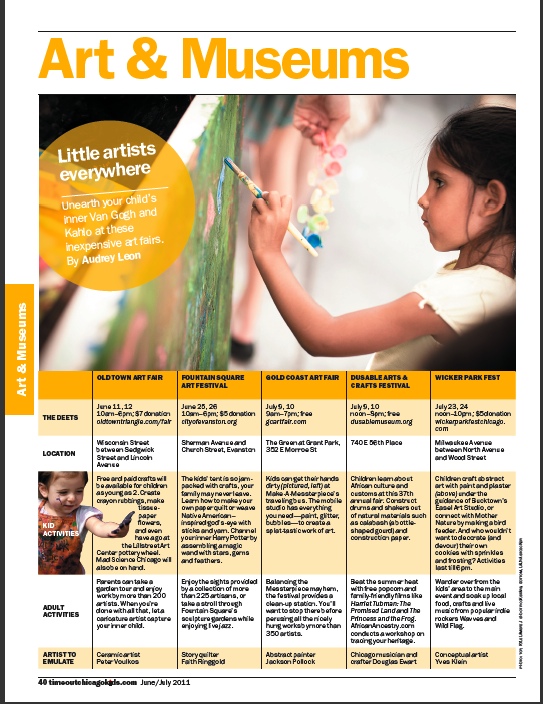
Living Art: Chicagoans celebrate Dia de los Muertos
Originally appeared in the October/November 2011 issue of Time Out Chicago Kids Magazine.
 Click here to download full article.
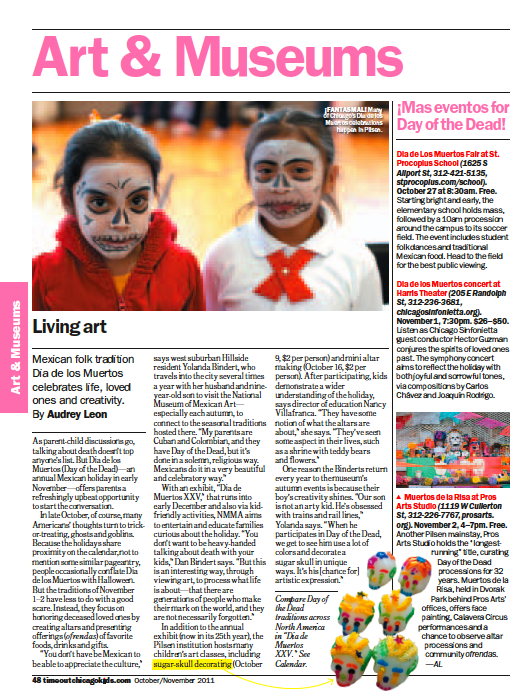
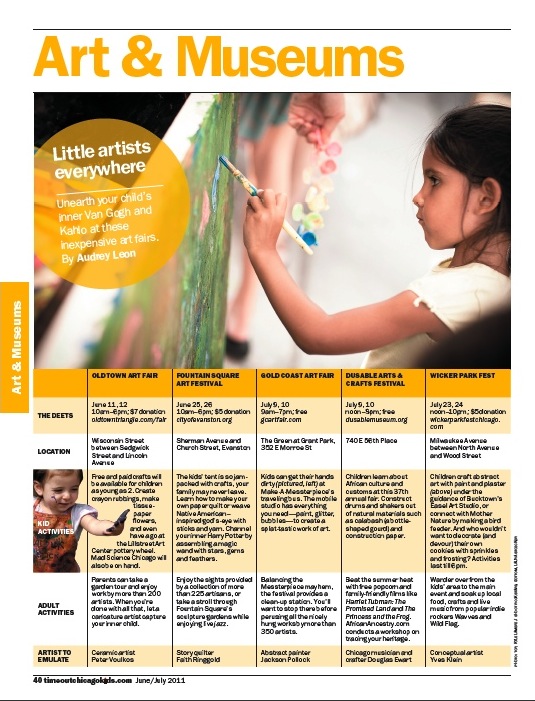
Little Artists Everywhere – Charticle
Originally appeared in the June/July 2011 issue of Time Out Chicago Kids Magazine.
Click HERE to download the full-size PDF file.
Behind the Scenes with Fugscreens
This article was originally published on LoudLoopPress.com on March 18, 2011.
 |
| Zissou Tasseff-Elenkoff and his newborn son Inka stand in the back office of Fugscreen studios on 1735 N. Ashland Ave., in Chicago. (Photo by Audrey Leon) |
By Audrey Leon
The building that houses Fugscreens Studios may be nondescript amongst the many sterile office buildings and schools that surround it on North Ashland Avenue, but the work that goes on inside is anything but.
The silk screener’s name isn’t as recognizable as Jay Ryan and Spudnik Press, but its gig poster handiwork can be seen around town at clubs like Schubas, The Empty Bottle or The Hideout on any given night.
“It snowballed a lot in the last year and a half,” said Fugscreen founder Zissou Tasseff-Elenkoff, a 2006 graduate of the School of the Art Institute of Chicago, of the studio’s visibility.
Tasseff-Elenkoff attributes this new found attention to his studio partly to moving into the commercial space on 1735 N. Ashland Ave. nearly two years ago. “It opened us up to professional contacts and enabled us to have interns and resident artists,” he said.
Plenty of up-and-coming bands such as Radar Eyes and Ornery Little Darlings, as well as underground ladies’ wrestling league the Mudqueens are repeat customers for Fugscreens’ designs and print work for their own promotional needs.
When Tasseff-Elenkoff talks about his studio’s success – such as landing big clients like Corona or the Jack White-helmed super group Dead Weather – he mentions luck. However, Mudqueens’ founder Meg Bell attributes it to talent.
“Zissou’s screen prints are amazing, unique and Chicago-centered,” Bell said. “I haven’t found anything else like it.”
Bell and the band Radar Eyes were turned on to Fugscreens by Dumpster Babies drummer Paul Puschautz.
“Paul would design our fliers and he found a guy (Zissou) who would print them for a reasonable price,” said Radar Eyes guitarist Anthony Cozzi. “We did a bunch of them and they turned out great.
“I always really liked what he was doing,” Cozzi said.
Retro rocking duo Ornery Little Darlings didn’t come to Zissou, he came to them, frontman Jason Ewers said.
“We were playing a Lincoln Hall show (last May) and he asked to do the poster for it,” Ewers said. “We had a cool response and we’ve continued and continued.”
With Fugscreens having printed or designed many of Ornery Little Darlings’ posters, Ewers hesitated to pick a favorite.
“My favorite poster is always the new one and always the next one,” he said.
Tasseff-Elenkoff started Fugscreens out of his apartment over three years ago as a way to further his own art. Tasseff-Elenkoff said he began teaching by chance after a potential roommate inquired about lessons after seeing his home set up.
He soon began taking on students such as long-time patron Louie Russo. Russo, his sister and mother all came to Tasseff-Elenkoff to learn silk-screening to further their own artistic creativity.
“It was a nice outlet for me,” Russo said. “I realized what screen printing was and what I could do with it.”
And now it is even easier for those interested in screen printing to take classes at Fugscreens. The studio began working with Groupon to offer large group (10-14 people) classes starting Thursday, March 24 and continuing for the next five months.
“It’s going to be intense,” Tasseff-Elenkoff said. “People tried to advise me against it, but it’s good for the shop.”
The 28-year-old father of a newborn said ideally he would rather focus on his own fine art prints and gig posters, but believes teaching has its own rewards.
“I like teaching, especially when you get someone who’s interested and really loves doing it,” Tasseff-Elenkoff said.
For those looking to get into screen printing on their own Tasseff-Elenkoff said it is tough, but doable.
“Chicago has one of the strongest print communities in the country,” he said, “It has a long history so there’s a lot of equipment hanging around that you could get inexpensively.
“Have confidence in what you do and go for it,” Tasseff-Elenkoff said.
Contemporary Art Pops Up in Loop Storefronts
Originally published by the DePaulia student newspaper on March 8, 2010.

(Con)Temporary Art Space, 208 S. Wabash, is the latest project by Pop-Up Art Loop. The temporary gallery opened on Feb. 18 in the former South Loop home of Ritz Camera. (Photo by Audrey Leon)
By Audrey Leon
The economy may be rough for Chicago businesses but a new initiative by the Chicago Loop Alliance aims to transform empty storefronts into temporary art galleries one vacant property at a time.
Pop-Up Art Loop launched in 2009 opening three galleries around the Loop in late November. The organization uses donated properties, which would otherwise sit vacant until renters could be found, and places artists inside for free.
Ty Tabing, executive director of the Chicago Loop Alliance, said the group was inspired by similar programs in other cities called “phantom galleries.”
Pop-Up Art Loop’s (Con)Temporary Art Space , 208 S. Wabash, officially debuted on Feb. 18 in what once housed a Ritz Camera store. Blue camera-shaped neon signs, left from the previous renter, still adorn the walls in the gallery.

Photo by Audrey Leon
(Con)Temporary Art Space is the brainchild of Ed Marszewski and his cohort from Co-prosperity Sphere, 3219 S. Morgan St., which includes artists Emily Clayton, Serena Himmelfarb, Chris Roberson and Marszewski’s wife, Rachael. Marszewski also runs “Lumpen” and “Proximity” magazines from his home base in Bridgeport.
While artists are now encouraged to submit proposals to the Pop-Up Art Loop Web site, Marszewski said he was approached by the Chicago Loop Alliance to formulate a project.
The (Con)Temporary Art Space also includes a reading room, featuring local publications, a gift shop, and gallery space on walls and in the room’s many display cases.
The space also features a unique interactive mapping project. “The mapping project allows people to come in and pin a location of something that they find culturally important about Chicago whether it’s a restaurant or public art display,” Rachael Marszewski said.

Photo by Audrey Leon
The benefits of having temporary art galleries in vacant storefronts are numerous. For Tabing and the Chicago Loop Alliance, the benefit is making empty buildings more attractive to new businesses. For the artists at (Con)Temporary Art Space, the benefit is simply exposure. “A downtown location gives us the change to reach people who wouldn’t experience this type of art,” Ed Marszewski said. “It’s more difficult for people to show their work in Chicago and [the Pop-Up Art Loop initiative] helps.”
Rachael Marszewski agrees. “Most of us are a group of artists that are used to working on the periphery of the city,” Rachael Marszewski said. “It’s a good opportunity for us and the artists we’re involved with to have a central location, which we could never really afford to be in or have would it not be for free.”
The local business community has been mostly receptive, Tabing said. “Some have and some have not,” Tabing said. “We’re finding that property owners in Chicago give a damn and those in other cities, like New York, don’t.”

Photo by Audrey Leon
DePaul University, which has an enormous presence in the South Loop, supports the initiative. “DePaul has been a big part of the cultural and economic revitalization of the South Loop and we welcome creative initiatives that further revitalize the Loop,” said John Holden, DePaul University spokesman, via email.
While the number of visitors has been sparse, this does not discourage the artists at (Con)Temporary Art Space. “[The gallery] is a great interactive project,” Ed Marszewski said. “I love seeing people who don’t know what’s going on.”
The (Con)Temporary Art Space will host a new exhibition on Thursday, Feb. 24, from 4:30 p.m. to 8:30 p.m., featuring the paintings of Polish artist Anja Jamrozik as well as a diorama of lead Dungeons and Dragons figures made by the Marszewskis.
Pop-Up Art Loop currently features four galleries, including the (Con)Temporary Art Space. Tabing suggests checking the Web site (popupartloop.com) for news on the latest gallery openings.
Bailiwick Repertory Chicago Reopened and Reinvented
Originally published by the DePaulia on Feb. 1, 2010.
By Audrey Leon
After 25 years, Members of the now defunct Bailiwick Repertory Theater have reunited under a new brand for a new season of shows.
Dubbed Bailiwick Chicago, the new theater company’s first show of the 2010 season is the musical revue “Show Us Your Love,” which features songs from famed musicals such as “Hair,” “Pippin,” “Aida,” and “Closer than Ever.”
“Show Us Your Love” is one of three smaller revues that will serve as fundraisers for future Bailiwick shows including a stripped-down version of Elton John’s “Aida.” Bailiwick Chicago hosted an open mic night on Jan. 31, at Joey’s Brickhouse on 1258 W. Belmont Ave.
“Bailiwick Repertory had a reputation for bold works and we want to keep challenging ourselves,” said Julie Burt Nichols, Bailiwick grants and development officer.
Bailiwick Repertory was renowned for its quality productions of “Animal Farm,” “Jerry Springer: The Opera,” its yearly rendition of “The Christmas Schooner” and its premiere of Dennis DeYoung’s “The Hunchback of Norte Dame.” Bailiwick was one of the first Chicago theaters to embrace the gay and lesbian community by staging its summer Pride Series.
The view that Bailiwick Repertory was known for its exemplary work is not one-sided. “Bailiwick was extremely well regarded for its daring, exciting work,” said Alan Salzenstein, League of Chicago Theatres board member.
When longtime artistic director David Zak left Bailiwick Repertory in September 2009- a year after the company lost its home of 15 years at 1229 W. Belmont Ave. due to financial troubles- Bailiwick’s board of directors dissolved the company, said Kevin Mayes, executive director of Bailiwick Chicago. Members had no choice but to start over.
“I saw it as an opportunity for folks who had worked at the Bailiwick in the past to create something they could really invest in,” Mayes said. “It was an opportunity to transfer brand recognition.”
However, Salzenstein believes there is a lot of baggage attached to the Bailiwick name. “Bailiwick has a founder’s perception,” Salzenstein said. “It was David Zak.”
The new Bailiwick Chicago is still homeless, but loving it.
“We’re happy to be transient,” said general manager Kate Garassino. “This way we can focus on our art and our audiences.”
Finding a permanent home is not out of the question. “Once we’ve searched out and figured out who we are and what kind of space we want to be in, that [finding housing] will definitely happen,” Mayes said.
Salzenstein believes Bailiwick Chicago’s story is just beginning.
“Chicago is very supportive of those who feel the entrepreneurial spirit in the arts,” Salzenstein said. “If they have creative people on every level, the sky’s the limit.”
Theatergoers can catch performances of “Show Us Your Love” at Hamburger Mary’s at 5400 N. Clark St. every Sunday night in February.
 // Audrey Leon //