Category: Energy
BP’s Approach to Collaborative Contracting
Audrey Leon looks at how BP’s new approach to working with its suppliers have led to quicker project start-up (Originally published in OE, January 2018).
 “We’re not goldplating anymore,” stated BP’s Global Projects Organization Head, David O’Connor, at the supermajor’s Houston Media Day in early December.
O’Connor said BP sought to change the way it does business in the hope of achieving cost cuts and boosting project efficiency and reliability amongst its many suppliers.
“In the past, we would tell our suppliers exactly what we needed and they would give us exactly what we asked for whether they could provide it easily or not,” he said.
O’Connor said BP went to its suppliers to better understand what they can best deliver, and adjusted its requirements to be in line with what they deliver. He also said that BP has begun engaging their suppliers earlier in the process. “No longer do we specify to them everything that we want,” he adds. “We look to them for their solutions to meet our requirements.”
O’Connor said that this new approach has helped BP bring projects in under budget and ahead of schedule. All seven of BP’s (operated and non-operated) projects slated for 2017 have begun – with Zohr achieving first gas in late December 2017.
Rob Kelly, vice president, Technical Functions, Global Projects Organization, also spoke about the new supplier-led approach at the event. “We have simplified and made our standards fit-for-purpose rather than over-engineered,” Kelly said. “Over the last four years, we have been focused on supplier-led solutions and actually having that conversation with our suppliers where we have global agreements and long-term relationships.
“From that, we gained significant benefits because we are actually asking them to build things that they are good at building. And therefore, they know the scope very clearly, and they are very efficient in how they can deliver. Obviously, we get benefit through price and schedule, and in terms of pace, but we also benefit in terms of the quality of what they deliver, building the hundredth thing they have built before, rather than the first bespoke thing they’ve built for BP.”
Into the wild
But, what’s next? BP is looking to modernize and transform the way it currently interacts with suppliers on their global projects, and that means digitalization.
Kelly discussed the importance of digital performance management and how BP is conducting a pilot project with its supplier where the supermajor links into the supplier’s database in the cloud.
“Almost in real-time, that allows the project teams to see status, rather than wait 4-6 weeks to get the normal report,” he says. “This is big step change for us. If you can have the right data, sooner, you can make earlier and better decisions.”
Kelly said that BP is trialing this on the Tortue Phase 1a project offshore Mauritania and Senegal.
Another area where BP seeks to boost efficiency is in construction and commissioning.
Kelly highlighted the Juniper project, which BP brought online this year, where the supermajor used “e-completions” or electronic completions to cut down on paper. “When you are doing completions, you can have thousands of systems that need to be checked prior to commissioning.” He said workers were outfitted with ruggedized iPads to do the job instead.
Still, Kelly stresses that suppliers are the key to a successful project. “We only do 10% of the activity – the rest – 90% of activity and man-hours is done by suppliers,” Kelly said. “The change we are trying to make, in becoming more digital in the way we design, procure and construct our projects, we need to work on with the supply chain.
“We are talking about collaborative contracting. We looked at other industries – particularly the infrastructure industry in the UK – if you are working in the same database with transparency of data that is shared, it leads to a different way of working. We spent a lot of time looking at that. We are working toward implementing this in our 2018 projects. It’s very exciting. You have to work more collaboratively with the supply chain.”
Download full PDF here.
The fruits of Mexico’s labor
Mexico’s energy reform efforts have been realized with recent successes from prior bid rounds. Now, Mexican national Pemex has added a steady schedule of farm-outs in shallow and deep water. Audrey Leon surveys the plays on the agenda. (Originally published in OE, August 2017).
 Mexico has worked tirelessly over the last three years to bring its energy reform to fruition, and the last piece of the puzzle was its own national oil firm, Pemex. In December 2016, Pemex finally found its first joint venture partner (BHP Billiton) for the Trion field, in the deepwater Gulf of Mexico, through a competitive bid process. Now, Pemex is ready to do the dance again.
At its first-ever farm-out day in Houston, CEO José Antonio González Anaya reiterated his company’s and the Mexican government’s commitment to making the energy reform work. And one of those ways is through seeking more partnerships to develop existing resources, on- and offshore.
“We have a historic opportunity to use all the instruments and flexibility available from the energy reform, he told the audience. “Before, [only we] were able to explore and produce and commercialize anything to do with oil. Now anyone can touch it, foreign and domestic. Now Pemex can partner with anyone – foreign and domestic – to do this.”
At the farm-out day event, Mexican officials announced four new farm-out opportunities: two onshore Tabasco, one in shallow water – Ayin-Batsil, in the Campeche Basin, and one in deepwater – Nobilis-Maximino in the Perdido Basin, adjacent to Trion. Mexican regulator, the National Hydrocarbons Commission (CNH), will again run the bidding process for the farm-outs, as they did in 2016 when determining a joint venture partner for Trion.
“Our role is to run the bidding process, and to ensure that this is a transparent and fully accountable process,” said Juan Carlos Zepeda, CNH president commissioner, at the Pemex farm-out day in Houston.
Ayin-Batsil
Pemex E&P Director General Gustavo Hernandez was on hand to add more detail on the plays added to the farm-out agenda. The Ayin-Batsil area, he says, offers 359 MMboe of undeveloped 3P reserves, mostly heavy oil, in shallow water, with multiple fields to develop.
“It’s an important field,” González Anaya said. “There’s a lot of oil.
“Why didn’t do this field [Ayin-Batsil] on our own,” González Anaya asked. “The water is a bit deeper than we are used to. We are an expert in shallow water, but most of our fields are in 80-120m water depth. That’s why we left it there to be done.”
The total area of the complex is 1096sq km in water depths ranging 150-170m, deeper than the shallow water fields in which Pemex normally operates, he said.
González Anaya added that there is infrastructure nearby – the Litoral-A central processing platform, which is 24km from Ayin-Batsil and 50km from shore – to plug into production and take production onshore. “You still have to build a 50km pipeline from where we are to the existing infrastructure Pemex has. But the infrastructure is there. That’s why we waited,” he said.
Ayin was discovered in 1991. Initial production rates from Ayin-Batsil, Hernandez said, were between 1200 b/d and .32 MMcf/d (Batsil) and 8200 b/d and .33 MMcf/d (Ayin). There were 10 exploration and appraisal wells drilled, from 1988 to 2015, that intended to characterize the block, Area E-0027-M, he added. There are two other fields that comprise the Ayin-Batsil area, including Makech and Alux.
Hernandez said that Ayin is the most relevant field with 60% of the total 3P reserves. Batsil is second in size with 20% of the 3P reserves. Alux and Makech could potentially be developed as subsea tiebacks to Ayin and Batsil, he said. The nearby Litoral-A facility has a storage capacity of 200,000 b/d and 600 MMcf/d, which, as of 2016, had a 75% utilization rate, Hernandez said. Also in the same area, there are two Dos Bocas gas and oil pipelines with 600 MMcf/d capacity, at 80% utilization rate, and a 200,000 b/d capacity with a 10% utilization rate, respectively.
There are also three additional exploratory opportunities, which could offer 224 MMboe of prospective resources (average, unrisked) – Ichal, Ken, and Chelpul – all which have 25-26° API oil.
Nobilis-Maximino
Another opportunity, this time in deepwater, is Nobilis-Maximino, which sits in 3000m water depth in the Perdido Fold Basin, adjacent to previous discoveries Trion and Great White. A total of nine wells have been drilled on the Nobilis-Maximino.
When Maximino was drilled in 2013, Pemex then-described the find as the “crown jewel.” The Maximino-1 probe was one of Pemex’s deepest wells, at 9515ft water depth. Nobilis was discovered later in 2016. The Nobilis-1 exploration well, on the eastern flank of the Maximino field, is 220km off the coast of Tamaulipas at 3000m water depth. Pemex said both exploration wells (Nobilis-1 and Maximino-1) proved light oil of 40° API.
According to Pemex, the main reservoir in Nobilis is in the lower Eocene Wilcox. The Nobilis-101 exploration well, drilled in 2017, tested a separate structural closure to the northeast in the Wilcox. Pemex said it discovered oil in the upper Eocene and Oligocene reservoirs.
The 1524sq km Nobilis-Maximino area has 3P reserves of 502 MMboe of light oil, and estimated production of 300,000 b/d. Nobilis-Maximino is 26km from Great White, and 40km from Trion.
In addition to Nobilis and Maximino, there are two other discoveries: Supremus and Mirus. Pemex said a further 627 MMboe could be had in prospective, unrisked resources in three additional exploration prospects – Chachiquin-1, Maximino-1001, and Maximino-3001.
Maximino, which Pemex called the most second important of the block, has 41 API light oil, with 187 MMboe in 3P reserves. Nobilis is 42 API light oil with 315 MMboe in 3P reserves. Supremus, the only find with heavy oil (28 API), has 98 MMboe contingent resources in the Oligocene. Mirus has 41 API light oil with 73 MMboe contingent resources. Pemex believes that Supremus and Mirus could be developed as subsea tiebacks to Nobilis-Maximino.
The farm-out for Nobilis-Maximino is expected to run in parallel with the next deepwater round 2.4, in January 2018, Pemex said.
A future so bright
SENER’s Aldo Flores-Quiroga highlighted the success Mexico has already enjoyed since the reform passed. “We have done in three years what no other country has in terms of reform,” he said. “Today, we have 54 companies working in Mexico’s E&P sector.”
As a result of the first five bidding cycles, Flores-Quiroga said that Mexico expects US$57 billion in investment. They have already signed 49 new contracts and have participation from 17 countries.
Flores-Quiroga also mentioned that the new five-year plan will offer 509 exploration and production blocks, and 82 production fields. “The aim is to present these at auctions by 2019,” he said. “We will announce six months before the round. We aim to make the process more standardized.”
Of the 509 blocks, Flores-Quiroga said 119 are deepwater blocks with prospective resources of 6594 MMboe and an average block size of 1000sq km. The blocks are in three basins, the Salina del Istmo, Cordilleras Mexicanas, and Perdido. The next deepwater rounds will be scheduled for January 2018 (Round 2.4) and October 2018 (Round 3.2), he said.
There are also plenty of shallow water blocks up for grabs. Flores-Quiroga said that there are 112 blocks with prospective resources of 3555 MMboe with an average block size of 400sq km. The shallow water blocks are in three basins – Burgos (near the US/Mexico maritime border), Tampico-Misantla (offshore Veracruz), and Sureste (offshore Tabasco and Campeche, and home to Eni’s Amoca and Talos’ Zama discoveries).
Historic finds
No doubt Mexico’s energy reform efforts will not only be measured in monetary success but in production volumes as well. Two days after Pemex’s farm-out day in Houston, Talos Energy announced it made an estimated 1.4-2 billion bbl, “world-class” light oil discovery at the Zama-1 exploration well, offshore Mexico. Wood Mackenzie called it one of the 20 largest shallow water finds in the past 20 years, and the first for the private sector.
Zama-1 was drilled in 166m water depth, about 37mi (60km) off Tabasco, in the Block 7 in the Sureste Basin, using the Ensco 8503 semisubmersible.
The well reached an initial shallow target vertical depth of approximately 11,100ft (3383m). Talos said it hit a 1100ft (335m) oil bearing interval, with 558-656ft (170-200m) of net oil pay in Upper Miocene sandstones with no water contact. The firm said initial gross original oil in place estimates for the Zama-1 well range from 1.4-2 billion bbl. Oil samples indicate light oil, with API gravities between 28-30° and some associated gas.
On the same day as Talos’ announcement, Italy’s Eni said its Amoca field, inside Area 1 in the Sureste Basin, has 1 billion boe of resources in place. Eni said that the Amoca-3 well proved the presence of multiple significant oil levels in the Orca and Cinco Presidentes Formations. Amoca is 1200km west of Ciudad Del Carmen, in the Bay of Campeche in 25m water depth. The Amoca-3 well was drilled to 4330m total depth and encountered 410m of net oil pay (25-27° API), in several high-quality Pliocene reservoir sandstones, of which 300m were found in the deeper sequence of Cinco Presidentes, in various cluster levels of Pliocenic age with good reservoir characteristics.
The total resource base estimate for Area 1 is 1.3 billion bbl of oil in place, according to Eni. The Italian explorer plans to submit an accelerated and phased development plan in 2017 targeting an early production phase with a plateau ranging from 30-50,000 b/d, with the start of operations planned for early 2019.
Download full PDF here.
Mexico’s big opportunity
Audrey Leon chats with Statoil’s Helge Hove Haldorsen about the positive results emerging from Mexico’s energy reform, how it compares to Statoil’s own experience as a state-owned operation, and its overall strategy in the Mexican Gulf. (Originally published in OE, May 2017).
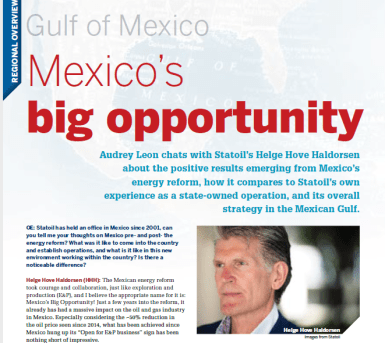 OE: Statoil has held an office in Mexico since 2001, can you tell me your thoughts on Mexico pre- and post- the energy reform? What was it like to come into the country and establish operations, and what is it like in this new environment working within the country? Is there a noticeable difference?
Helge Hove Haldorsen (HHH): The Mexican energy reform took courage and collaboration, just like exploration and production (E&P), and I believe the appropriate name for it is: Mexico’s Big Opportunity! Just a few years into the reform, it already has had a massive impact on the oil and gas industry in Mexico. Especially considering the ~50% reduction in the oil price seen since 2014, what has been achieved since Mexico hung up its “Open for E&P business” sign has been nothing short of impressive.
So far, Mexican authorities have successfully completed four transparent and competitive bid rounds; a total of 55 areas have been bid out to the industry leading to 39 awards; 49 new E&P companies have been established in Mexico – of which 25 are new Mexican independents, and 12 producing fields are now being operated by other companies than the national oil company Pemex.
In this period, Pemex has also farmed down and handed over operatorship of its Trion deepwater discovery, and also took part in its first open and competitive bid round in the recent deepwater tender. All of this has taken place in just a couple of years, which speaks to the impressive work-rate and commitment of the Mexican government to this new Mexican energy model.
And, this is only the results of the so-called Mexican Round 1. Round 2 has already been announced, and we’re looking forward to consecutive tenders throughout the year for new opportunities in shallow water, onshore and in deepwater areas. The recently updated Mexican five-year plan outlines more opportunities in the years to come, which helps provide the overview and predictability that is so important to industry. Mexican authorities – spearheaded by Energy Secretary Joaquin Coldwell, CNH President Juan Carlos Zepeda and others – have done a remarkable job thus far.
Let me also mention AMEXHI, the new Mexican upstream association with some 50 members including Pemex. This has become an important member of the new E&P ecosystem in Mexico interacting with the authorities and institutions on important policy and regulatory matters – sharing global best practices in both technical and policy matters.
OE: Statoil (in consortium with BP and Total) picked up two blocks (1 and 3) in the Saline Basin during Mexico’s deepwater round in December 2016, and Statoil has participated in previous shallow water rounds. Could you discuss why it was important for Statoil to participate from the very beginning – some companies including majors have been absent from the rounds so far.
HHH: Statoil’s interest in Mexico has always been driven by the opportunities that we see, and our bid round participation so far has been driven more by the subsurface than any strategic wish per se to enter early. It was the subsurface potential that we saw that drove our participation in the shallow water tenders of Round 1, and it was again the prospective potential – albeit with the increased risk and uncertainty of this frontier area – that led us to participate in the deepwater tender together with our strong partners BP and Total.
At the same time, there may of course also be benefits to companies entering Mexico early. They may get a head start in terms of developing the necessary subsurface understanding, regional knowledge and commercial grounding to succeed. But ultimately, our interest in Mexico is driven by – as much as it is dependent on – material opportunities and globally competitive terms and conditions.
OE: What is your strategy for Mexico, including your current acreage?
HHH: Statoil entered Mexico in 2001, and has a long-term perspective in the country. We’re committed to reviewing opportunities that fit Statoil’s strategy and competency areas, assuming globally competitive terms and conditions. Of course, as one of the world’s largest offshore operators, our interest is primarily offshore. We’ve also built up a sizable onshore business in the US over the last decade, so we are not entirely discounting onshore opportunities in Mexico either.
The key for all upcoming opportunities in Mexico, however, is that they are able to compete for capital against other opportunities in Statoil’s global portfolio. And since we have been able to reduce the breakeven price for our next-generation and non-sanctioned portfolio from over US$70 to now less than $30, future opportunities in Mexico really need to be very good to compete!
OE: Related to the previous question, which offshore areas (either shallow or deepwater) are considered to be the most exciting areas for exploration?
HHH: Mexico has a significant yet to find potential offshore, particularly in the more frontier deepwater areas. Most of the Mexican deepwater is either underexplored or not explored at all, which of course from an exploration perspective is very exciting. So, we are very pleased about our two recently awarded blocks in the deepwater Saline Basin of Mexico, together with our partners BP and Total.
These are significant, frontier areas, with considerable subsurface uncertainty but with play-opening potential. There is a lot of running room here, so we are optimistic about our chances, but a lot of work still remains to be done to further mature and prove up this acreage.
On the whole, shallow water areas in Mexico are considered to be more mature, given that this is where the majority of Mexico’s offshore exploration and production has taken place over the years, so the remaining exploration potential here is most likely also less prospective. Having said that, the Sureste is a very prolific basin, and there will most likely also be “hidden or overlooked gems” in this area as well.
OE: What does the current upstream E&P scene look like in Mexico in your view? What is your perspective on current activity off Mexico?
HHH: It is very exciting to see so many new players coming into Mexico, especially the fact that you now have 25 new Mexican E&P companies in the country. No one would have thought that 2-3 years ago.
From Statoil’s perspective, this can only be good for Mexico. More companies participating will mean more eyes looking at the seismic, more ideas about where the oil flows, and ultimately more wells and discoveries.
I am also of the opinion that this new Mexican energy model will ultimately also be very good for Pemex, which Pemex CEO Jose Antonio Gonzalez Anaya also said at CERAWeek in March. If we draw a comparison with Statoil’s experience in Norway, I think it will be clear that having multiple E&P companies can actually be to the benefit of the national oil company. In this way, through partnerships and collaboration, we were able to learn from some of the best, and by also having to compete with the same companies it forced us to continuously improve. I believe it has been a key part to Statoil’s success.
So with Pemex already being one of the largest producers worldwide, I think they have every reason to benefit from the influx of ideas and investments that the new Mexican energy model brings. Indeed, Pemex is already benefiting – just look at the interest and the investments they got with Trion, and now they are looking at farming down several other fields and discoveries as well.
OE: What are some of the challenges Statoil sees in the Mexico market (workforce, technology, etc.), and what are some ways the company has worked to resolve them?
HHH: I think it is important to remember that while the Mexican market is new to many of the recent upstream entrants, the oil and gas industry has been flourishing in the country for about 100 years.
Mexico already has a strong and competent oil and gas supplier industry, and a very well developed economy in many other areas as well. And if you look beyond E&P, Mexico also has very competitive and technologically advanced automotive and aerospace industries – with people, knowledge and competencies that can be further leveraged for the benefit of the oil and gas industry going forward as well.
As the industry moves into newer and less familiar areas in Mexico, such as deepwater and unconventionals, it will be key for companies such as ours that we work with our local counterparts and suppliers to transfer and strengthen skills also in these areas. Working to establish links between suppliers, universities and research institutes both in Mexico and abroad will also be important in this regard.
OE: What is the long-term outlook for Mexico’s oil and gas industry from your perspective?
HHH: From Statoil’s perspective, the long-term outlook for oil and gas in Mexico looks very good. The energy reform, and the new Mexican energy model which it triggered, has given Mexico a great opportunity.
Indeed, the International Energy Agency (IEA), in a recent publication addressing the outlook for energy in Mexico to 2040 with and without the energy reform, concludes that the Mexican nation and the Mexican people can look forward to material benefits from the reform if it is executed in a manner that provides the predictability and investor security needed to attract the required risk capital and activity level.
But, there is a sense of urgency here. To deliver on this potential there is a need to increase and incentivize activity. Only through exploration activity and by drilling wells will the significant yet to find potential in Mexico ever be proved up. And it is only by increasing activity that people will start seeing the true benefits – employment, investment and revenues – of oil and gas and the new Mexican energy model. And indeed, if you give any credence to the recent estimates of “peak oil demand,” it is a strategic objective for Mexico to monetize its hydrocarbons while they are still needed.
According to an assessment by AMEXHI, the upstream oil and gas association in Mexico, as many as 20-30 wildcat wells are needed each year to deliver the increased production estimated in the IEA report.
So while Mexico is off to a great start, even more needs to be done to incentivize early activity (e.g. by adjusting the bid formula to give increased weight to the work program). Only in this way will Mexico be able to deliver on its potential and deliver the full and true benefits to citizens and industry alike.
OE: Is there anything else that you would like to add?
HHH: I would like to reiterate my belief that the energy reform is ‘Mexico’s Big Opportunity.’ In the IEA report mentioned earlier, two scenarios are compared: A 2015-2040 journey for Mexico without the energy reform implemented and another scenario with full energy reform implementation. When the two forward scenarios are compared, it is clear that full energy reform implementation delivers many key long-term benefits to Mexico and the Mexican people: Oil production in 2040 is more than a million barrels per day higher, the cumulative GDP during 2015-40 is about a trillion dollars higher, oil revenues are ~$600 billion higher and investments are almost $300 billion higher. If the energy reform were not implemented, Mexican authorities would have had to compensate for the lack of income with higher taxes and lower state and federal budgets. ‘It takes a village’ to deliver ‘Mexico’s Big Opportunity.’
The Mexican authorities have so far been very good ‘neighbors’ promulgating an open dialogue with the players in the E&P industry. This collaboration has already secured many win-wins as global best E&P practices have been brought to Mexico.
The following two areas require special and continued attention:
• The Bid Formula: In the current bid formula, extra royalty is given a weight factor of nine compared to extra work program offered (and the extra work program is capped at two wells). This set-up makes it possible to win a block by bidding high extra royalty and zero wells.
This is hardly in Mexico’s interest as the extra royalty is only seen if a discovery is made starting with the first oil production 5-10 years from now offshore. In real estate, they say that three things are important: location-location-location. What Mexico needs now is: activity-activity-activity!
Every exploration well is a ‘snowball’ of activity in the Mexican oil states and if a commercial discovery is made, the ‘snowball’ grows big in a hurry when it comes to activity: employment, investments, all the way to production and income. Mexico should perhaps start defining success through the number of offshore wild cats drilled per year with 20/year as the goal as noted above.
Nothing can deliver ‘Mexico’s Vision In The Gulf’ more than activity-activity-activity. The most important ‘lever’ to pull to achieve this is the terms and conditions offered by Mexico compared to other countries. What if Mexico, by design, decided to offer the best terms in the world? ‘Economic Gravity’ would then attract even more risk capital to Mexico leading to more activity and more discoveries quicker.
• Contract Administration: Contract administration could be much more efficient with the introduction of electronic signature and data transfer.
There is too much paper and copying and signing. The carrot is that costs are lowered and Mexico becomes more competitive and business friendly.
Helge Hove Haldorsen is Director General Statoil Mexico in Mexico City. Haldorsen previously served as Vice President Strategy & Portfolio Statoil North America in Houston. Prior to joining Statoil, Haldorsen worked for Norsk Hydro in various senior roles. Haldorsen earned an MS in Petroleum Engineering from the Norwegian Institute of Technology in Trondheim and a PhD in Reservoir Engineering from The University of Texas. He also served as SPE President in 2015.
Download full article here.
Thunder (Horse) rolls
Audrey Leon profiles the Thunder Horse field, speaking with project manager Steve Raymer about the BP-operated field’s most recent expansion project, which came in 11 months ahead of schedule and $150 million under budget. (Originally published in OE, May 2017.)
 This year is set to be an exciting one for BP. The firm is looking to bring seven projects online in 2017. One project, the Thunder Horse South Expansion (THSX) in the deepwater Gulf of Mexico (GoM), was originally slated for start up in late 2017, but it had the good fortune to come online earlier than scheduled, due to good planning and execution.
The THSX project is expected to boost production at the Thunder Horse facility by an estimated 50,000 gross boe/d.
BP achieved this with the installation of two new 11,000ft flowlines, and a four-slot manifold, which creates a new subsea drill center (No. 45), 2mi south of the Thunder Horse platform.
The THSX project started up in December 2016, 11 months ahead of schedule. BP saw US$150 million in savings on the $1 billion project. Bringing a project online quickly and cost-effectively is quite a boon in today’s low oil price environment. These kinds of numbers are positives that plenty of oil and gas firms will want to replicate.
BP acknowledged the success the firm has had at previous GoM projects, such as its Kepler field, which ties back to BP’s Na Kika platform.
“We are also making significant progress in exploration by shortening our cycle time from discovery to production on some of our latest discoveries,” said CFO Brian Gilvary in BP’s 3Q 2016 analyst call. “Our Nooros discovery in Egypt was on production two months after discovery and Kepler-3 came online within 11 months of discovery, which is faster than typical GoM developments of this scale.”
The main drivers for bringing THSX online ahead of schedule and under budget were standardization, cooperation between suppliers and contractors, and great planning and coordination on execution efforts, says Steve Raymer, THSX project manager, BP.
The field
While Thunder Horse is one of BP’s largest fields in the GoM, it hasn’t been the easiest to develop. This is owed to its complex geology and mother nature’s whim.
Discovered in July 1999, BP did not bring the field into production until 2008, three years after its initial target, due to issues stemming from a direct hit by Hurricane Dennis (2005).
BP operates Thunder Horse (75%) along with co-owner ExxonMobil (25%). The field sits inside Mississippi Canyon blocks 778/822 in the Boarshead basin, 150mi southeast of New Orleans in water depths ranging from 5800-6500ft.
Thunder Horse consists of two adjacent fields (North and South) with reservoirs in the Upper Miocene turbidite sandstones. In BP’s fact sheet on the field, the company calls the wells required to access the reservoirs, “some of the most challenging and deepest in the Gulf.”
The development consists of subsea wells producing to a permanently moored, floating semisubmersible production, drilling and quarters (PDQ) facility. The PDQ, which is BP’s largest facility in the GoM, is taut-wire moored in 6300ft water depth. It has 250,000 bo/d and 200 MMcf/d of natural gas processing capacity, and accommodation for nearly 300, BP said. Oil and gas is exported through the Mardi Gras Transportation System.
BP awarded FMC Technologies a frame agreement in 2001 to provide the field’s subsea production system, which is designed for 350°F and 15,000psi and operated via an electro-hydraulic controls system. The field has 5in x 2in conventional subsea trees and manifolds. Round-trip pigging capability is incorporated into the manifold architecture, FMC (now part of TechnipFMC) says.
Geology
According to a 2010 OTC paper on Thunder Horse, some two-thirds of the oil in place is in the South with one-third in the North. North and South share a common aquifer in the syncline separating the two regions, says Arnold et. al.
The paper describes Thunder Horse South as a large 4-way dip closure that begins at approximately 20,000ft true vertical depth subsea (TVDSS) and persists to 30,000ft TVDSS. Arnold et al said that half of the closure lies below a thick salt canopy.
Arnold et. al describe Thunder Horse North as a large 3-way dip closure against a near vertical salt stock. The paper says that there is a high degree of lateral stratigraphic and structural segmentation. The closure lies below the salt canopy, which also results in poor imaging (similar to Thunder Horse South).
Multiple stacked reservoirs are found in Miocene age sandstones on both the North and South fields, the paper states, which are grouped as Pink, Brown, and Peach stratigraphic intervals.
“Not all of those are developed at every drill center in the North or South,” Raymer says. “By and large, the North is Pink and Brown, and the South is Brown and Peach.”
Raymer says that the sections grouped as Pink, Brown and Peach denote different reservoir sections, depths, pressures and hydrocarbon composition. “They have different properties that result in different production,” he says. “They can all mix together and produce together. Part of the beauty and part of the challenge is developing those three different reservoir sections.”
Field improvements
Since start up in 2008, BP has steadily worked to improve production from the field. In May 2016, the supermajor started up a water injection project on the North field, with the goal of extending production life and recovering an additional 65 MMboe.
Aimed at Thunder Horse’s North Pink geology, the water injection will boost overall recovery within that section of the field, Raymer says.
“It’s always been in Thunder Horse’s long-term plan to have water injection as part of the overall development concept to deliver full recovery from the field,” he adds. “We are seeing a good response from the project and we’re very happy with it.”
Expansion
Raymer says that when the Thunder Horse field was initially developed, BP knew to provide for future expansion.
“When we first sanctioned Thunder Horse, we knew it would be a massive field,” he says. “We put the infrastructure in to initially develop a good chunk of that. And, while we did that, we also recognized that we didn’t have perfect understanding of the reservoir.”
Raymer says that, as time has gone by, and BP drilled more wells in the South, the firm increased its knowledge about not only the size of the reservoir, but how best to develop it.
“It became clear that the most economical way for us to [develop it] was to add another drill center and expand an area of the field that we called South Expansion, to tie into the existing infrastructure, using the expansion capability that we built in initially,” he says.
Part of what made the THSX project so successful is the use of standardized components and working with contractors who had previously provided equipment on the field.
Raymer says that for THSX, BP wanted to use what Thunder Horse already had. “We had an existing subsea tree design,” he says. “All we had to do was call FMC Technologies and order a few more. We had existing subsea equipment, the same manifold design. We did not redesign anything from scratch where we had the opportunity to use something that we already had.”
The project came together quickly. Raymer says BP ordered its first long-lead equipment in August 2014, taking delivery of most of that equipment around August/September 2016. “We installed the majority of that equipment toward the back end of 2016 and we brought production on in December.”
In 2015, Technip, prior to its merger with FMC Technologies – another supplier on the project – was tasked with design, engineering, fabrication, installation and pre-commissioning of the new production pipeline systems on THSX. The project scope included: project management and engineering; coating, fabrication, installation and permanent anchoring of two rigid, 3.25km production flowlines, each with four pipeline end terminations; pre-commissioning and testing. Technip’s ultra-deepwater pipelay and subsea construction vessel, Deep Blue, handled offshore installation work.
Deep Blue unspooled and lowered the two new flowlines to the seabed over a period of eight days, with the help of Helix’s Grand Canyon II, to connect the existing drill center below the Thunder Horse platform with the new drill center, according to BP Magazine.
Grand Canyon II assisted with the pull-in operations as well as pre-commissioning work for the flowlines once they were installed on the seabed.
BP also used the subsea construction vessel, Siem Stingray, to install the rest of the subsea equipment including production manifolds and jumpers.
Overcoming challenges
One major hurdle that plagues most large-scale developments is the scheduling of simultaneous activities. Raymer said that the THSX project came together because of good communication and well-coordinated project execution.
“There was a high amount of SIMOPS (simultaneous operations) going on in the field while we were doing our construction,” Raymer says. “The Thunder Horse asset itself was drilling a well as well as producing. We had [Transocean’s] DD3 [Development Driller III] drilling our first South Expansion well at drill center 45 – where we were putting all the expansion equipment.”
Raymer adds that while those operations were going on, Technip was in the process of laying the flowlines with Deep Blue.
“Just in that time frame alone in summer 2016, we had three extremely valuable assets working together in close proximity, and we were able to complete all that construction work without disruption to the ongoing production and drilling activities that were occurring simultaneously,” Raymer says. “While it certainly was a big challenge, it was also our greatest success as a project to be able to deliver that work safely, without incident and without any disruption to operations.”
Planning played a big role as well in executing the project’s SIMOPS.
“We did an enormous amount of upfront work,” Raymer says. “We employed some 3D modeling techniques to explicitly map out and model the paths that the flowline installation vessel would need to take. We did similar 3D models showing any required offsets or movements that the drilling rigs might need to do while operating.
“Once we had all that technical information, then, the bulk of the work from that point is communication, and regular engagement sessions with the leadership and the operations managers of each of the different assets coming together, and being very clear on the roles and responsibilities on the execution plans and on the scope of work, and the timing that we were all going to follow to orchestrate the execution of all this activity.
“That coordination was a major driver towards us being able to deliver the project 11 months ahead of schedule,” Raymer says, adding: “Being able to do all those things simultaneously (flowline, subsea equipment construction and installation at the same time as drilling and completions of the wells), made the execution extremely efficient versus having to do all those things one at a time, in a series.”
Of course, another potential challenge, like with any offshore project in the GoM, is mapping out a window to execute work before the worst of Hurricane season. BP is famous for its severe weather assessment team, which boasts a team of meteorologists who keep tabs on GoM storm conditions.
For the THSX project, BP ran into a spot of good luck due to a relatively mild 2016 hurricane season.
“We specifically aimed for and targeted a window of opportunity that was right before the start of hurricane season,” Raymer says of the THSX project. “We were able to get this flowline installation done in the late July/beginning of August time frame. And that was before the active part of hurricane season, allowing us to minimize that risk.
“If there had been a storm that had come through, during that time, we had contingency plans in place to be able to postpone and re-assemble post-event as necessary. But, fortunately, that wasn’t the case for us.”
What’s next?
Raymer says that BP expects to see an increase of 50,000 boe/d at the field. “We have two of our four wells online, at this point, with the third currently being drilled (by the West Vela),” he says. “The fourth is in line to be done after that.”
BP expects full production to be achieved at THSX in 2019.
Work cited
Arnold, G., Cavalero, S. R., Clifford, P. J., Goebel, E. M., Hutchinson, D., Leung, H., … Grass, D. B. (2010, January 1). SS: Thunder Horse and Atlantis Deepwater Frontier Developments in the Gulf of Mexico: Thunder Horse Takes Reservoir Management to the Next Level. Offshore Technology Conference. doi:10.4043/20396-MS
Fanning the (E&P) flames
All eyes may be on Guyana, but there’s plenty of other countries worthy of attention in South America. Audrey Leon surveys the current spike in exploration activity in the region.
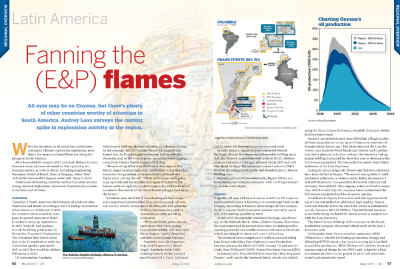 While the downturn in oil prices has cooled many companies offshore exploration aspirations, more than a few majors and small firms are taking the plunge in South America.
After ExxonMobil’s massive 2015 Liza find offshore Guyana, there are many who are interested in that upcoming oil-bearing country, as well as others, including neighboring Suriname. South of Brazil, there is Uruguay, where Total drilled the then-world’s deepest water well, Raya, in 2016.
Traditional oil-bearing countries such as Colombia are also seeing renewed exploration investment from both international and national oil firms.
Colombia
Colombia is South America’s third largest oil producer after Venezuela and Brazil, according to the US Energy Information Administration. At the end of 2016, the country’s state-owned oil company Ecopetrol announced that it intended to ramp up exploration in 2017, both off- and onshore, to curb its falling production. In November, Ecopetrol’s Exploration Vice President Max Torres noted that of the 15 exploration wells the Colombian operator planned to drill in 2017, five would be offshore (OE: January 2017).
US Independent Anadarko Petroleum is drilling offshore Colombia. In February, during its Q4 earnings call, the Houston-based oil company confirmed that the Purple Angel exploration well spudded in December and, as OE went to press, operations were ongoing, using Fred. Olsen’s Bolette Dolphin drillship.
“We are testing effectively the Kronos discovery in this Purple Angel location right now,” said Ernest A. Leyendecker, executive vice president of International and Deepwater Exploration, during the call. “When we’re done, we’re going to go up north and test another analogous structure to the feature we’re on right now, called Gorgon. So, really a lot more to come in the context of the Grand Fuerte area gas frontier in the future.”
Anadarko also said that it is evaluating multiple large-scale opportunities identified from the Esmeralda 3D seismic survey, which covers about 30,000sq km and potential drilling locations for possible operations in 2018 are being evaluated.
“We’re obviously pretty encouraged about what we’re seeing,” Leyendecker added, who described the acreage as “pretty deepwater out there in the Grand Col area.”
Anadarko has a 50-50 partnership with Ecopetrol on Purple Angel. Anadarko holds 100% working interest in the Gran Col area (Blocks Col 1, Col 2, Col 6 and Col 7), where the Esmeralda survey was conducted.
In early January, Spain’s Repsol contracted Maersk Drilling’s Maersk Developer semisubmersible drilling rig to drill the Siluro-1 exploration well in block RC-11, offshore western Colombia. Drilling is planned for Q2 2017 and will take about 42 days. The estimated contract value is US$12 million, including mobilization and demobilization, Maersk Drilling says.
According to a 2014 presentation by Repsol, Siluro is a lower Micocene Carbonate prospect, with 1.6 Tcf gas resources, in 90m water depth.
Guyana
Arguably, all eyes will be on Guyana in 2017, as US supermajor ExxonMobil aims to fast-track its recent major finds in the country. According to Exxon’s Q4 earnings call late January, the firm expects final investment decision on Liza by year’s end, with start-up possible by 2020.
In mid-2015, ExxonMobil confirmed the huge Liza discovery, in the Stabroek block, 120mi offshore Guyana. Ever since, the supermajor and its partners have been evaluating and increasing potential recoverable resource estimates at the block, which are thought to hover well over 1 billion boe.
The Stabroek block comprises 6.6 million acres (26,800sq km). Exxon subsidiary Esso Exploration and Production Guyana operates the block with 45% interest. Its partners include Hess (30%) and CNOOC Nexen Petroleum Guyana (25%).
In January 2017, ExxonMobil then made the ultra-deepwater Payara-1 well, inside the Starbroek block, which was drilled using the Stena Carron drillship to 18,080ft (5512m) in 6660ft (2030m) water depth.
Payara-1 encountered more than 95ft (29m) of high-quality, oil-bearing sandstone in two upper Cretaceous reservoirs of Maastrichtian-Aptian age – like those found at the Liza discovery, says analysts Wood Mackenzie. Exxon said a production test is planned to further evaluate the discovery and appraisal drilling is planned for later this year to determine the full resource potential. The Payara field is about 10mi (16km) northwest of the Liza discovery.
During its Q4 earnings call, Exxon said that two sidetracks have been drilled at Payara. “We moved very quickly to drill additional sidetracks in order to better define the reservoir,” said Jeff Woodbury, vice president of investor relations and secretary, ExxonMobil. The company said a well test is underway, which would help the company better understand the full resource potential and development options.
In addition to Payara, Exxon also said that appraisal drilling at Liza-3 identified an additional high-quality, deeper reservoir directly below the Liza field, which is estimated to contain between 100-150 MMboe. This additional resource is currently being evaluated for development in conjunction with the Liza discovery.
The Stena Carron drillship will move next to the Snoek exploration prospect, about 6mi (10km) south of the Liza-1 discovery well.
In December 2016, Exxon awarded contracts to SBM Offshore for a 100,000 b/d floating production, storage and offloading (FPSO) vessel, a key step in moving the Liza field toward first production. SBM Offshore will perform front-end engineering and design for the FPSO, and, subject to a final investment decision on the project in 2017, will construct, install and operate the vessel.
At the time, Exxon also said it had applied for a production license and submitted its initial development plan for the Liza field to the Guyana Ministry of Natural Resources. The plan includes development drilling, operation of the FPSO, and subsea, umbilical, riser and flowline systems.
Wood Mackenzie said in early February that there are huge expectations for Guyana to become a serious upstream player by the next decade, despite the challenges associated with developing an oil industry from the ground up. “It’s not often that a country goes from zero to 60 so fast like this,” Matt Blomerth, Wood Mackenzie head of Latin America upstream research, told the New York Times in January.
“After [Exxon] drilled a dry hole at the Skipjack prospect in September, Payara and Liza-3 reconfirmed the high potential of the Cretaceous play in Guyana’s deepwaters,” Wood Mackenzie said in a statement in January. “Payara’s proximity to Liza enables economies of scale for the area’s development. The Guyanese government’s approval of a $500 million oil and gas service hub on Crab Island will give added impetus.”
Of course, there are challenges ahead, including a lack of infrastructure. Wood Mackenzie estimates wellhead gas volumes of 2.1-2.5 Tcf between Liza and Payara. “With no offshore infrastructure or nearby gas market, the partners will face high costs to dispose whatever gas that cannot be reinjected or flared,” the consultants said.
However, Wood Mackenzie’s analysis of Guyana remains optimistic, saying in January that Guyana’s production could reach 350,000 b/d by 2023.
To address some of the country’s growing needs, Guyana’s Ministry of Natural Resources announced in January that it plans to have a new petroleum directorate established and functioning during Q1 this year.
The ministry says the new directorate will follow international models that separate policy development from regulation monitoring. A $965,000 (GY$200.7 million) budget was allocated in the 2017 for petroleum management.
Elsewhere in Guyana, UK Independent Tullow announced in February that it plans to acquire 3D seismic data over the offshore Orinduik license, awarded in 2016, and the Kanuku license. Both are up-dip of the Liza discovery. The two programs are expected to cover up to 6000sq km and will enable evaluation of attractive leads mapped on existing 2D seismic data.
Suriname
Tullow’s Exploration Director Angus McCoss referred to the Guyana-Suriname basin as the industry’s “hotspot at the moment,” in the company’s Q4 earnings call early February, and its Araku prospect there, a “game-changer.” The company is calling its test of the Araku prospect, in offshore Block 54, its “main drilling event” this year.
Tullow plans to drill the high impact Araku prospect in 2H 2017. McCoss said that the reservoir Tullow is targeting is a Maastrichtian, a younger Cretaceous turbidite sand, and a similar-aged rock to what Payara is targeting off Guyana.
The block has a large structural trap with resource potential of 500 MMbo, and has been significantly de-risked by a 4000sq km 3D seismic survey carried out in 2015, says Tullow. A rig is currently being sourced for the well, which is expected to cost $14 million net to Tullow to drill. The Block 54 contract area is 8824sq km and is about 200km offshore in the Suriname-Guyana Basin.
“It’s a giant prospect over a 300sq km closure,” McCoss said. “It’s a four-way structural closure. This is a structural closure, it’s a dome-shaped structure, which is a good, safe, lower risk type of prospect to go for.
“[There] is a lot of follow-up potential in this area,” he continued. “It’s not just this play. There are other plays there are stratigraphic plays, carbonate plays. A great set of opportunities. We’re hopeful for Araku. [It] is our best prospect in the portfolio. But, should it not [be], there are a lot of alternative play types to follow-up on in this rich acreage.”
For Tullow and its partners Statoil and Noble Energy, the well is not just about opening a new play area, but also an exercise in keeping well costs down.
“The $14 million net to Tullow relates to about $40-45 million gross well cost,” McCoss explained. “Now, if you compare that to previous years that would have cost about $100 million to drill. So, you can see [there is] quite a very significant offshore cost deflation in the sector that we’re taking advantage of.”
Other players with acreage in Suriname include US independent Hess, which is partnering with Exxon for Liza offshore neighboring Guyana. In May 2016, Hess picked up a one-third stake in Block 42 offshore Suriname from US-based explorer Kosmos Energy.
In Kosmos’ Q3 earnings call, the firm said that it began a new 3D seismic survey of Block 42 in Suriname near the Peruvian-Guyana Suriname Basin, adjacent to the Liza discovery, in October 2016. Results are expected in early 2017. Kosmos’ Chairman and CEO Andy Inglis said that the firm hopes to drill toward the end of 2017, into 2018, into Turonian-aged source rock. Inglis says there is a drill-ready prospect in Block 45, different from the trend seen in Liza offshore Guyana.
US-based Apache has interest in Blocks 53 and 58 offshore Suriname. In the company’s Q3 earnings call, CEO John J. Christmann said the firm is very excited about its prospects in Suriname.
Timothy J. Sullivan, executive vice president, operations support, said during the call that Apache completed a 3D seismic shoot on Block 58 in September 2016, and expects to have a fully processed data set by Q3 2017. In Block 53, Apache will drill an exploration well in Q1 2017.
“While this is an attractive and sizable exploration prospect (in Block 53), very few wells have been drilled to this depth offshore Suriname, and as such, carries a significant amount of risk,” Sullivan said during the call in November. “The dry hole cost to Apache for this well is estimated at less than $40 million.”
Peru
In February, Regulator PeruPetro approved UK-based Baron Oil and partner Uruguay-based Union Oil and Gas Group’s (UOGG) plan to drill the Cuy-Z34-13-1X exploration well offshore of northwest Peru in Block Z-34, some 15km from an existing producing field in the offshore/onshore Talara Basin.
The well will be drilled in 5764ft of water to a total depth of 12,553ft. Block Z-34 is in an undrilled deepwater basin and covers a 3713sq km area. Baron’s internal estimates of gross unrisked best estimate (P50) prospective resources for the Cuy prospect is 413 MMbbl recoverable.
UOGG, which holds 80% interest, is continuing farm-out efforts for a partner to share the drilling costs. Baron hold the remaining 20%. The well, according to Baron, cannot be drilled until another partner comes on board, in addition to contracting a semisubmersible drilling unit, and all permits in place.
Uruguay
Uruguay has been in the spotlight because French oil major Total drilled the then-deepest water well in the world, Raya-1, there in 2016, using Maersk’s ultra-deepwater Maersk Venturer drillship. However, while the Raya reservoir was believed to be good, not much more information has been released about the prospect since.
“Uruguay has been successful in making attractive offshore areas open for exploration activities,” says Adrian Lara, senior upstream analyst, GlobalData. “So far key major companies have participated and some, such as Shell, BG, Tullow Oil, ExxonMobil and Inpex, remain in the country doing exploratory activity. Round 3 is supposed to be announced soon and is aimed at continuing collecting exploratory information on the offshore areas.”
In January 2017, Tullow started a 2500sq km 3D seismic program offshore Uruguay to capture data over high-quality leads identified in Block 15 in the Pelotas Basin.
One Step Ahead
Daniel Sack, of EMAS Chiyoda Subsea, has spent three decades in the oil and gas industry following and participating in the next big step changes in technology – one subsea project at a time. Audrey Leon found out more. Originally published in OE, November 2016.
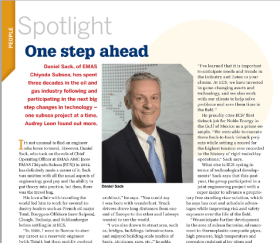 It’s not unusual to find an engineer who loves to travel. However, Daniel Sack, who took on the role of Chief Operating Officer at EMAS AMC (now EMAS Chiyoda Subsea [ECS]) in 2012, has definitely made a career of it. Sack was smitten with all the usual aspects of engineering: good pay and the ability to put theory into practice, but then, there was the travel bug.
His love affair with traveling the world led him to work for several industry leaders such as French oil major Total, Bouygues Offshore (now Saipem), Clough, Technip, and Schlumberger before settling in at ECS.
“In 1988, I went to Borneo to start my career as a reservoir engineer (with Total), but then rapidly evolved towards offshore facilities construction in West Africa and Southeast Asia (with Bouygues Offshore),” he says. While the subsea industry was evolving in the 1990s, he switched to installing conventional platforms and pipelines, and later moved to Australia in the mid-1990s, as subsea was starting to take off. He soon found himself in Houston.
“I was attracted to the sheer size and depth of the development in water depth multiple times the height of the Eiffel Tower and with a footprint on the seabed the size of Paris,” he says of the subsea field. “The scale of these projects was impressive and developing them was very challenging.”
Sack didn’t always think he’d be an engineer. “My earliest career aspirations were to be a truck driver or an architect,” he says. “You could say I was born with wanderlust. Truck drivers drove long distances from one end of Europe to the other and I always wanted to see the world.
“I was also drawn to structures, such as, bridges, buildings, infrastructure, and enjoyed building scale models of boats, airplanes, cars, etc.,” he adds. “The oil and gas industry has allowed me to fulfill most of my childhood dreams on a much larger scale than I could ever have imagined.”
Sack’s subsea journey continued at Schlumberger in 2006, where he helped lead the development of a deepwater subsea well intervention system and later developed the early production facility group. However, by 2012, ECS approached Sack with a new opportunity.
“This was a great opportunity to start-up and build a new company using the systems, assets, people and lessons learned from top tier contractors. It was very exciting to offer clients a reliable alternative to the very large and often bureaucratic contractors,” he says.
In terms of his attitudes toward technological developments, Sack says: “I’ve learned that it is important to anticipate needs and trends in the industry and listen to your clients. At ECS, we have invested in game-changing assets and technology, and we also work with our clients to help solve problems and save them time in the field.”
He proudly cites ECS’ first tieback job for Noble Energy in the Gulf of Mexico as a prime example. “We were able to execute three back-to-back tieback projects while setting a record for the highest tension ever recorded in the history of rigid reeled-lay operations,” Sack says.
What else is ECS eyeing in terms of technological developments? Sack says that this past year, the group participated in a joint engineering project with a super major to advance a proprietary free standing riser solution, which he says has cost and schedule advantages while improving risk and safety exposure over the life of the field.
“We anticipate further development in the area of subsea factories, advancement in thermoplastic composite pipes, high pressure, high temperature and corrosion resistant alloy pipes and enhanced welding and coating applications, just to name a few,” he says.
ECS has plenty of jobs, large and small, lined up so far, including a US$1.6 billion engineering, procurement, construction and installation project for the Hasbah field offshore Saudi Arabia in consortium with Larsen & Toubro, as well as a contract with Eni Ghana for the Offshore Cape Three Points development, slated to begin in early 2017.
“We are also working alongside our clients right now to find economic solutions for the next generation of ultra-deepwater developments,” Sack says. “Many of these developments are already beyond the edge of current technology or capability, and we take pride in finding solutions to these challenges that work for our clients.”
Breaking new frontiers
Shell’s Stones development will be home to the Gulf of Mexico’s second FPSO, but while it may be No. 2, the FPSO may hold a few firsts itself. Audrey Leon found out more. (Originally published in OE, September 2016).
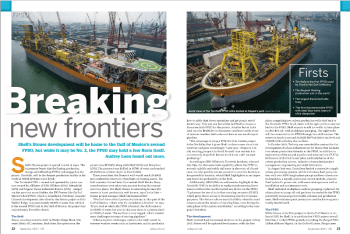 Shell’s Stones project is special in a lot of ways. The supermajor boasts that the floating production, storage and offloading (FPSO) unit engaged on the project, Turritella, will be the deepest production facility in the world at 9500ft (2900m) water depth.
The Turritella FPSO – owned and operated by a joint venture owned by affiliates of SBM Offshore (55%), Mitsubishi (30%) and Nippon Yusen Kabushiki Kaisha (15%) – nudged out the previous record holder, the BW Pioneer (the Gulf of Mexico’s first FPSO), which is installed at Petrobras’ Cascade/Chinook development, also close by the Stones project within Walker Ridge, in approximately 8900ft of water. But, while it is the second FPSO unit in the Gulf of Mexico, the project has enjoyed many firsts (See chart).
The field
Stones was discovered in 2005 in Walker Ridge Block 508, some 200mi off Louisiana. Back then, the operator on the project was BP (59%) along with Shell (26%) and Marathon (15%). The prospect was drilled in 9576ft of water and reached 28,560ft true vertical depth in March 2005.
Three years later, the Stones-3 well would reach 29,400ft and confirm the discovery of multiple oil-bearing sands. The field consists of nine Outer Continental Shelf blocks. Many considerations were taken into account during the concept selection phase. For Shell, Stones is interesting because the reservoir is not particularly well known, says Curtis Lohr – Stones project manager, Shell International E&P.
“We don’t have a lot of production history in this part of the Gulf of Mexico – that’s why it’s considered a frontier,” he says. “If you look at where the FPSO is located, the drill center is in 9500ft of water, but also in this area there is a plateau that’s in 7500ft of water. The sea floor is very rugged, which created some challenges in terms of routing pipelines.”
Other potentials challenges, native to the Gulf, would be extreme weather events such as hurricanes, and in particular, how to safely shut down operations and get people out of harm’s way. This was one factor that led Shell to choose a disconnectable FPSO for the project. Another factor, Lohr said, was the flexibility to disconnect and leave in the event of extreme weather, but to also not have to use an oil export pipeline.
“The advantage of using a FPSO for this frontier project is the flexibility that it gives Shell –to learn more about this reservoir and grow accordingly,” Lohr says. “Stones is a really exciting prospect for Shell. It could turn out that it is an extremely large find, but we won’t know until we start producing.”
According to SBM Offshore’s Turritella factsheet, released this May, the disconnectable capability allows the FPSO to not only quickly and safely sail away in the event of a hurricane, but also quickly resume production once the hurricane has passed the location, which Shell highlighted as an important factor for productivity at the field.
Additionally, SBM Offshore said another highlight of the Turritella FPSO is its ability to readjust each mooring line’s tension without the need to install any device on the FPSO. “It pioneers the use of an in-line mooring connector (ILMC), which gives direct access to the mooring line for re-tension purposes. This feature allows more flexibility when the need arises to adjust the tension of mooring lines, even during the early phase of the system installation,” according to the company’s factsheet.
The development
Shell reached final investment decision on the project in May 2013. Stones will be a phased development, with the first phase comprising two subsea production wells tied back to the Turritella FPSO. In all, there will be eight wells connected back to the FPSO. Shell expects to add six wells, in later phases after first oil, with multiphase pumping. The eight wells will be connected to the FPSO through two drill centers. The reservoir depth is around 26,500ft (8077m) below sea level and 17,000ft (5181m) below the mudline.
In October 2015, Technip was awarded the contract for the development of subsea infrastructure for Stones that includes two subsea production tiebacks to the FPSO, in addition to engineering of the second pipeline end terminations (PLETs); fabrication of the PLETs and piles; and installation of the subsea production system, inclusive of associated project management, engineering and stalk fabrication.
In August last year, OneSubsea landed a contract to supply subsea processing systems, which includes a dual pump station with two 3MW single-phase pumps and two subsea control modules, a topside power and control module, a barrier-fluid hydraulic power unit with associated spares as well as installation and maintenance tools.
Shell indicated multiphase seafloor pumping is planned for a later phase to pump oil and gas from the seabed to the FPSO, potentially increasing recoverable volumes and production rates. Shell estimates peak production could achieve approximately 50,000 boe/d.
The FPSO
While Stones is the first project in the Gulf of Mexico to utilize a FPSO for Shell, it is not their first FPSO project overall. Shell has 11 other FPSOs globally including the Bonga FPSO, 120km offshore Nigeria, in the Gulf of Guinea. Bongacame online in 2005 at 3281ft (1000m) water depth. It’s one of the largest FPSOs in the world, measuring 300m long and 12 stories high; the deck is the size of three football fields. The FPSO, when full with oil, weighs 300,000-tonne.
Lohr has worked with Shell for over 30 years on some of the company’s biggest deepwater frontier projects, such as Auger, Bonga, Perdido, and now Stones. Lohr joined the Stones project in 2010.
“The exciting thing about all the Shell projects I’ve been involved with and what they have in common is that they are all deepwater frontier projects,” Lohr says. “And in many cases these projects opened up new frontiers in different regions.
“Auger, for example, opened up deepwater worldwide – that one is also in the Gulf of Mexico. Bonga did a similar thing for Nigeria, and Perdido is the deepest drilling and production system in the world. And now Stones will be the deepest production system anywhere (in 9500ft of water).”
Lohr says that with Stones, Shell opted to have contractor SBM Offshore design the facility, with the Shell providing the functional specifications.
“For Shell, most of our experience in the deepwater Gulf of Mexico has been with TLP hosts. Perdido being an exception,” Lohr says. “There was a learning curve, but (in terms of working with the US Bureau of Safety and Environmental Enforcement) they had the advantage of working with Petrobras (on Cascade/Chinook).”
In July 2013, Netherlands-based floating production contractor SBM Offshore was chosen to supply and lease the Stones FPSO, Turritella, which is a converted 159,000-dwt Suezmax tanker. The Turritella will be capable of producing 60,000 b/d of oil and 15 MMcf/d of gas. The hull will be able to store 800,000 bbl of oil.
At the time the contract was signed with Shell, SBM Offshore said the Turritella will be moored using buoyant turret mooring (BTM) technology, allowing the vessel to weathervane on location or to disconnect in the event of a hurricane. Steel lazy-wave risers (SLWRs) connecting the subsea facilities to the BTM will be used for the first time with a disconnectable FPSO, the company said at the time. Shell indicated the SLWRs have an arch bend, which absorbs the motion of the FPSO and boosts riser performance at extreme depths.
Lohr says that Shell has used both disconnectable FPSOs and SLWRs before, and for the first time brought these technologies together for the Stones project.
“For the SLWRs, we actually install buoyancy on the risers, so there’s a S-shape to them that helps to take some of the load off the buoy and the FPSO. We have used it before on other projects and we felt comfortable with this technology,” he says.
The Turritella underwent conversion work at Keppel Shipyard in Singapore with teams from SBM Offshore and Shell present.
“When we did the conversion in Singapore, one of the things we communicated to the contractor – Keppel – is even though this is not the largest FPSO in the world, even though it is not the most complicated FPSO in the world – it is still special because it is the deepest,” Lohr says. “We did that because we wanted them to understand that we wanted them to build something special with no harm. We have been very focused on safety – we have an outstanding safety record on the project.” And Lohr says there were over 13 million man hours spent on the construction of the FPSO in Singapore without incident. The Turritella set sail from Singapore to the Gulf of Mexico in November 2015 and arrived at its location in late December last year. “We’re working hard on (first production), and it should be sometime in the coming months,” he says.
In June this year, InterMoor announced it had completed the final tensioning and chain cutting operations on Turritella. InterMoor’s work scope consisted of chain final tension adjustments through the ILMC system, subsequent cut and removal of excess chain, and riser pull-in rope stretching and transfer to the FPSO.
Bruno Amann, project manager, InterMoor, said that work began around Christmas and wrapped in February this year. Amann says that the project was very particular and took about three months. He notes that normally it takes longer.
Amann discussed the work scope and cited weather as a challenge. “It was winter time, and we didn’t have optimal weather conditions,” he says. InterMoor used the Seacor Keith Cowan anchor-handling vessel (AHV) to perform first phase operations, and later used a larger construction vessel on charter and on standby. Amann says that the AHV was used primarily to keep costs down.
Meeting challenges
In addition to rugged terrain and weather conditions, there are other challenges to meet when working in deepwater frontier areas.
Lohr highlights designing umbilicals that could meet the challenges associated with the extreme water depth.
“It’s easy to say 9500ft of water, but more challenging to execute,” Lohr says. “Because of the water depth, the tension and the load on the umbilicals becomes quite high, and we actually had to work with the contractors to come up with something that works in this water depth.”
Additionally, Lohr highlights the disconnectable technology used on the project. “The way we worked with our contractors to meet the challenges of 9500ft of water is a very special thing.”
The 3D advantage
For Stones, Shell took advantage of 3D printing technology to ensure the disconnectable buoy on the project came together flawlessly during the construction process. The disconnectable buoy features a design that uses syntactic foam, unlike typical disconnectable buoys that are hollow steel. The buoy features 222 pieces of foam that need to fit together in sequence. Lohr says that the use of 3D printing technology to create a model allowed Shell to ensure that there weren’t any safety issues or schedule delays.
Shell produced a video earlier this year discussing how 3D printing came together to ensure the buoy construction went according to plan.
“A fundamental part of the design process is to visualize what the end product will be,” says Robert Patterson, executive vice president, engineering, Shell, in the video. “3D printing allows for very rapid prototyping; allows you to engage with a design, installation sequence, safety risks of putting it together. If you do all of those things early, it leads to far better outcomes.”
Amir Salem, construction engineering, Stones project, SBM Offshore, added: “Having a model like this bridges the gap between design and fabrication.”
Building blocks
Audrey Leon profiles Block Island Wind Farm, which is destined to be the US’s first offshore wind project when it starts up later this year (Originally published in OE, July 2016).
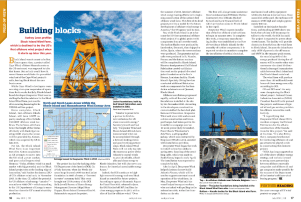 Block Island wasn’t meant to be first. Once upon a time, a project called Cape Wind, offshore Massachusetts on the US east coast, was supposed to take that honor. But, as luck would have it, several issues would take the proverbial wind out of the Cape Wind project’s sails, leaving Block Island the new frontrunner.
While Cape Wind’s developers were securing a two-year suspension of operations for its works last July, Rhode Island-based developer Deepwater Wind was installing the first foundations for the Block Island Wind Farm, just months after securing financing for its US$290 million project.
Once complete, Block Island, 3nm offshore Rhode Island, will have 30MW capacity, made up of five Haliade 150 6MW offshore wind turbines. The turbines, which are twice the height of the Statue of Liberty with blade tips towering 600ft above the water, will be provided by Alstom, which was acquired by GE in late 2015.
For GE, the Block Island Wind Farm is an important test of its Alstom acquisition as GE attempts to move into the US wind power market, and pose a challenge to rival Siemens. “Today, offshore wind is a small market with big potential, and the Block Island project sits at the leading edge of innovation,” said Anders Soe Jensen, CEO of GE’s offshore wind unit, in November 2015. At the time, GE called the potential for US offshore wind energy “massive” – around over 4000 GW – which according to the US Department of Energy is more than four times the US’ annual electricity production.
The project has had the backing of the US Department of the Interior (DOI). On 27 July last year, when the Weeks 533 crane barge lowered a 400-ton steel jacket foundation in 100ft of water, a “first steel in water” ceremony held. This event brought out US Secretary of the DOI Sally Jewell, Bureau of Ocean Energy Management Director Abigail Ross Hopper, Rhode Island Governor Gina M. Raimondo to support the project.
“Interior is proud to be a partner in this historic milestone for offshore renewable energy,” Secretary Jewell said last July. “Deepwater Wind and Rhode Island officials have demonstrated what can be accomplished through a forward-looking vision and good working partnerships. Block Island Wind Farm will not only tap into the enormous power of the Atlantic’s coastal winds to provide reliable, affordable and clean energy to Rhode Islanders, but will also serve as a beacon for America’s sustainable energy future.”
Indeed, the DOI continues to highlight renewable energy and sees Block Island as a model for future projects. According to agency’s Economic Report for Fiscal Year 2015, released in June, the DOI blocked off $97.3 million for clean energy programs in 2015, with a slice of that for offshore wind. “Over the summer of 2015, Interior’s offshore wind energy leasing efforts led to beginning construction of the nation’s first offshore wind farm. This first-of-its-kind project provides a model for the future development of offshore wind energy in America,” the US agency said in June.
But, while Block Island is set to become the US’ first operational offshore wind project, it’s a global project with components from all over the world. The turbine blades were produced in Lunderskov, Denmark, then shipped to Aviles, Spain, where the tower sections were produced. The generator and nacelle were produced in St. Nazaire, France, and the bottom sections will be completed in Rhode Island. Houston-headquartered Gulf Island Fabrication carried out fabrication work on the project’s five steel jacket foundations at the firm’s Houma, Louisiana facility. Rhode Island’s Specialty Diving Services conducted additional fabrication work on components for the foundation substructures at Quonset, Rhode Island.
Offshore installation progressed rapidly, with all five steel jacket foundations installed at the site by late November 2015. According to the developers, construction crews installed the last deck platform on 21 November. Deepwater Wind said about 200 workers and a dozen construction and transport barges, had taken part in the installation campaign over an 18-week period (July-November). Fred. Olsen’s Windcarrier’s Bold Tern, a self-propelled jackup, which was contracted by Deepwater Wind in 2014, assisted with installation activities.
Deepwater Wind began the work to install submarine cables in spring 2016. Spooling of the 20mi-long cable, which was made in South Korea, began in early April. The installation was expected to complete by July.
Also in April, Deepwater Wind helped christen the newbuild Atlantic Pioneer, which will be used to support construction and operation of the wind farm. In May, Deepwater Wind said the vessel helped transport workers, who are tasked with pulling-in the submarine cable, to the first foundation on the site.
The firm will also get some assistance from Louisiana-based Offshore Marine Contractor’s two liftboats Michael Eymard and Lacie Eymard, both of which arrived on-scene in Rhode Island in late April.
Deepwater Wind expects installation of the five offshore wind turbines to begin in summer 2016. To complete this work, a temporary manufacturing facility was established at the Port of Providence (Rhode Island) for the assembly of turbine components. It is expected to take six months to complete the installation of critical electrical, mechanical and safety equipment within the bottom tower sections. Once assembled at the yard, the turbines will measure 270ft high and weigh approximately 440-ton.
Installed on their jacket foundations, and standing at 589ft above sea level, the turbines will be among the tallest in the world, the DOI has said. The project is expected to power about 17,000 homes. The facility will provide electricity directly from the wind farm to Block Island. Because the island uses only 1MW of power in the off-season and 4MW in the summer peak season, the remaining 90% of the energy produced during the off season will be sent to other state customers via a 25mi bi-directional submerged transmission cable between Block Island and the Rhode Island mainland.
The wind farm will produce more than 100 million kilowatt hours of clean energy annually, according to DOI.
GE and DOI aren’t the only ones championing the Block Island project. National Ocean Industries Association (NOIA) President Randall Luthi praised the project, and its use of typical oil and gas service providers for offshore renewables work, last July.
“It is gratifying that Deepwater Wind chose NOIA member company Gulf Island Fabrication for the off-site construction of the foundations for this project,” he said at the time. “It is also fitting that a company best known for fabricating offshore oil and gas structures played a role in constructing this historic project.
“NOIA has long supported an all-of-the-above offshore energy strategy, and we look forward to seeing more partnerships between offshore renewable companies and offshore oil and gas companies made possible by the success of the Department of the Interior’s offshore wind leasing program.”
Intervening on Stone Energy’s Pompano
Unique fields deserve equally unique intervention solutions when production begins to wane, this was the challenge Stone Energy had to meet when it contracted Cross Group to develop new methodology and technology for its Pompano subsea production template. Audrey Leon reports. (Originally published in OE, April 2015).
 When Lafayette, Louisiana-based Stone Energy purchased the Pompano field from BP in late 2011, the field’s subsea intervention kit was in need of serious refurbishment while several subsea wells on Pompano Phase II, a 10-well subsea template remained shut-in.
In 2012, Stone Energy had 16 platform wells producing, and only three of 10 template wells producing. An intervention would be necessary, but the subsea system, the only one of its kind in the US Gulf of Mexico, had issues such as stuck tooling that made through-flowline (TFL) intervention unworkable, said Craig Castille, director of Deepwater Drilling and Completion at Stone Energy.
Before BP sold the field to Stone Energy, it mulled a total refurbishment of the original intervention kit, which is now-20 years old. Now that it was Stone’s challenge, Castille says the company estimated a total refurbishment of the original intervention kit could cost as much as $40-50 million and the operation and maintenance of the complex system would increase safety risks and cost. Castille says that the company knew there had to be a better way.
“Not having a system in place wasn’t an option,” Castille says. “We had no way to do plugging and abandonment work on these wells. It wasn’t an ‘if,’ it was how soon can we get it done?”
The field
Pompano was one of the first deepwater projects in the Gulf of Mexico and it remains a production hub for neighboring fields, including the ExxonMobil-operated Mica field (Stone Energy 50%), which is tied back to the Pompano platform through two, 8in flowlines.
The Pompano field was discovered initially in 1981 by ARCO (later part of BP) and Kerr-McGee (later part of Anadarko), and then re-evaluated and deemed economical in 1985. First oil followed in 1994. The 8mi-long Pompano field sits inside six lease blocks including Viosca Knoll Block 989 and Mississippi Canyon Block 28, about 120mi southeast of New Orleans, in 1100-2200ft water depths.
BP installed a 40-slot fixed platform in 1994, in the southeast corner of the Viosca Knoll block, in 1290ft water depth. Pompano’s 10-well diverless subsea oil production template system was installed in 1995 in Mississippi Canyon, about 4.5mi southeast of the platform, at 1865ft water depth 1 (Clarke and Cordner), with first oil in 1996.
The field’s Pliocene reserves and some of the offset Miocene reserves could be drilled from the platform with the use of extended reach drilling. The rest of Pompano’s Miocene reserves were developed using the subsea well template2(Cordner and Klienhans).
Through-flowline systems
In a 1999 SPE paper by then-BP Exploration engineers James P. Cordner and John W. Kleinhans, a TFL system, deployed from a moored mobile offshore drilling unit (MODU), was selected for the field’s subsea template after numerous concepts were evaluated2.
“Based on the results, the best match-up of reservoir needs, including uncertainty about both well count and reservoir management needs, indicated that subsea facilities comprised of a 10-well, subsea template structure and designed for production wells outfitted for TFL servicing would best meet objectives,” they wrote.
TFL was cutting edge technology when developed almost 30-40 years ago as an alternate solution to high cost, high mobilization drilling vessel intervention back into a subsea well. TFL was seen as the economic solution to Pompano’s unique and troublesome reservoir properties that might be plagued by several planned (and unplanned) interventions, says Brian Skeels, emerging technology director at FMC Technologies and an adjunct professor of subsea engineering at the University of Houston.
While Pompano is currently the only field using a TFL system in the Gulf of Mexico, it’s not the only one in the world.
“What started with Exxon’s SPS project at Garden Banks 70/71 back in the 1970’s later moved to Shell/Esso’s Central Cormorant project in the UK’s North Sea sector in the 1980s, and Statoil’s (Saga Petroleum) Snorre project offshore Norway in 1992. TFL was also experimented with on other North Sea pilot projects for Mobil and Conoco in the same era,” Skeels says.
Skeels, who serves on an API Subcommittee 17 executive committee, says that TFL continues to have its merits. “But, its cachet may have come and gone,” he says, when compared to some of today’s lower cost intervention solutions like monohull riserless intervention.
The way the TFL system works is that tools have to be pumped through a 4.5mi flowline from the Pompano platform and into a well in order to perform work that is typically done with slickline on conventional dry tree wells. This requires the TFL tools to be extremely flexible, almost like snakes, says Jason Leath, Director of Projects at Cross Group. “You have to pump them in and they go through a service loop in the tree and they go downhole. You have two production bores. You have to pump down one and reverse out, basically pumping your tool all the way back to the platform when it is done,” he says.
The key to TFL technology, Skeels says, is understanding how it works and then building and installing the equipment correctly with that “pump down and pump back” understanding in mind. “If the pipeline is improperly constructed (welding slag or misalignment of joints) or the trees do not feature the right chamfers and entry/exit angles, or later on you developed a production problem, the pipe was clogged with paraffins, or you had debris issues like sand or corrosion, you could really get yourself in a bind by sticking a TFL tool somewhere in the maze of piping,” Skeels says.
Stuart Morrison, a senior subsea engineer at Stone Energy who oversaw the completion workover riser (CWOR) design and refurbishment for the operator, says another problem is few people in the industry with this in-depth knowledge of TFL systems remain. Additionally, there’s only one company that provides the pump-down equipment for TFL systems, Otis (now Halliburton).
This meant Stone Energy had to find a way to intervene on its subsea template with an open mind, Morrison says, bringing in several intervention companies to offer solutions before eventually settling on Cross Group.
“We knew we had work to do, relative to the template,” Castille says. “The system was in ill-repair and needed to be refurbished. Because of the cost of rigs today, putting a rig on location for a very minor intervention was not cost effective.”
Stone Energy needed a more flexible system in order to carry out interventions on at least two wells that were shut-in, one of which had been out of production for 10 years. Stone laid out its needs, including the freedom to use DP semisubmersible or DP monohull vessel rather than a moored MODU.
Finding a solution
The Pompano field and its TFL system wasn’t a total mystery to Cross Group. Several team members overseeing the project had previously worked on the original equipment for BP while at Saipem, says Larry Klentz, vice president, Operations, Cross Group.
Cross Group’s proposal provided a new system, which would grant access to each wellbore and annulus through a new triple bore selector and valve assembly, allowing the work to be done with or without a riser. Working with Houston engineering firm OilPatch Technologies (OPT), the two companies created and manufactured this new system that would interface with both Cross Group’s upper intervention package and the existing triple bore vertical tree/TFL system.
OPT lead the design, analysis, drawings, manufacturing, and assisted with testing of the new system. The work took approximately 18 months, says Gary Galle, associate principal and director of new markets and new technology, OPT.
The biggest challenge, says Galle, was figuring out the requirements. Cameron made the original equipment and work on the new system meant working with Cameron, Cross Group, Stone Energy, and others to define and close interfaces.
Galle says by keeping the adaptor’s design as modular as possible, it allowed OPT to evolve with changing needs and requirements. “We broke it up into enough sub-components so that if we changed one, it wouldn’t change the overall design,” he says.
The technology
Cross Group considered several concepts before landing on the one selected, but this design in particular was, in-part, inspired by Klentz and his team’s previous experience on Pompano.
“We call it (the triple bore selector) a dynamic funnel,” says Klentz, who spent 14 years at Saipem before Cross Group. “It’s a hydraulic actuator that shifts from whichever of the three bores that is selected, and that allows you to select whatever bore in which you need to work. Under that adaptor is a valve block that gives you the ability isolate the other bores, as well as pump in ports, full circulation capabilities, giving you full access to your toolstrings.”
Klentz says while he and Leath were at Saipem, a 4×2 dual bore type package with a slickline run kickover tool was used on other projects. This allowed access to the annulus bore through a mono bore riser. “Building off that concept, originally, we thought we could do a hydraulic kickover, but this (adaptor) worked out to be the best, most efficient, fewer moving parts, if it breaks you can fix it easily.”
For the Pompano intervention, Cross Group paired the adaptor with its existing 3.0 riserless intervention system in conjunction with some select equipment from the original CWOR and the new dynamic funnel assembly to fulfill the scope.
Cross Group said that one of the hurdles for the project was the requirement to run e-line tractor tool strings – an ability the original CWOR did not possess. The minimum requirement was a system rated for 1865ft water depth and a bore pressure of 5000psi.
“Through our package, it allows work to be done from a monohull vessel, which is a much smaller vessel, with a much smaller day rate,” Klentz says. “The equipment spread is a quarter of what it would normally be, meaning lots of cost savings. It’s safer because they don’t have to set anchors, and can do it from a DP vessel.
“The package actually gives them greater capabilities because you can run larger vertical toolstrings through it than the original intervention package designed for this work,” Klentz says.
Leath, agrees, saying: “They went from the biggest, bulkiest, most expensive way to do it 20 years ago to one of the smallest, most mobile methods of doing it today. I don’t believe that type of thing has ever been done before.”
Crossing the finish line
Cross Group, was also requested by Stone to help prepare the RFP (request for proposal), which provided the technical requirements to find and contract an appropriate vessel. Based upon the vessel assessment for the intervention project, Cross Group chose the up to 2000m deep water offshore construction vessel BOA Deep C for the job. The BOA Deep Ccomes equipped with two ROVs, a 250-ton active heave compensated crane, and 1150sq m deck space. Cross Group staged its equipment on the vessel’s back deck.
The vessel arrived at the Port of Galveston in mid-November, and the crew set sail for the Louisiana coast shortly after Thanksgiving. The job was completed by mid-January with all parties proclaiming it to be a huge success (see table below for production figures), despite a few hiccups due to the currents, and weather limitations, says Kevin Smith, a completion engineer with Stone Energy who prepared the intervention work plans on the two wells to be serviced. Smith says the crew rigged up a work tower to minimize the wind limitation on the crane.
All parties involved in the intervention attribute its success to open lines of communication.
Jimmy Reed, senior deepwater drilling superintendent for Stone Energy, who was responsible for the overall execution of the work said that the biggest challenge for any project is getting everyone on the same page, and the companies (Stone Energy and Cross Group) were able to have daily conference calls and discuss not just the operations but HSE support with all parties involved.
“There was outstanding communication, HSE achievement, and to top all that off, we got the job done. All the new equipment functioned well,” Reed says.
“There were no issues safety wise, even with cramped quarters on which the personnel had to work; load on back of the vessel and perform the operations without getting injured, and no near misses,” he says.
The future
Castille says the intervention completed in January is just the beginning of the revitalization of the subsea template, saying Stone Energy has invested $30 million in new tree technology for two wells, which could be a future workover or sidetrack. In addition, the company continues to add to Pompano. It recently tied in two Cardona wells and will develop the Amethyst discovery as one well subsea tieback.
“Pompano is producing 14-15,000 b/d,” Castille says. “When we got it from BP production was at 4000 b/d.”
Works Cited:
[1] Clarke, D. G., & Cordner, J. P. (1996, January 1). BP Exploration’s Pompano Subsea Development: Operational Strategy for a Subsea Project. Offshore Technology Conference. doi:10.4043/8209-MS
[2] Kleinhans, J. W., & Cordner, J. P. (1999, February 1). Pompano Through-Flowline System. Society of Petroleum Engineers. doi:10.2118/54130-PA
API, RP 17C, Recommended Practice on TFL (Through Flowline) Systems, 2nd Edition, 2002.
Black Elk fire victim dies
Originally published at OEdigital.com on November 26, 2012.
A second worker has died of injuries sustained after a fire broke out on Black Elk Energy’s production platform in the U.S. Gulf of Mexico, the Philippine Embassy in Washington D.C. announced on 23 November 2012.
Baton Rouge General Hospital said 49-year-old Avelino Tajonera passed away due to complications from major burn injuries. Tajonera was one of four Filipino workers employed by Grand Isle Shipyard who had been hospitalized following the 16 November blaze on Black Elk’s production platform 18 miles offshore Grand Isle, Louisiana, in shallow water block West Delta 32.
Three workers remain hospitalized at Baton Rouge General; two are listed in critical condition and one, identified as Wilberto Ilagan, remains in serious but stable condition. Ilagan received burns on over 35% of his body.
Tajonera, of Dinalupihan, Bataan, is the fire’s second victim. The body of Elroy Corporal, 42, was recovered near the accident site on 17 November. A third worker, 28-year-old Jerome Malagapo, has not been found.
On Wednesday, the Bureau of Safety and Environmental Enforcement issued a strong rebuke of Black Elk Energy’s safety record. BSEE said the Houston-based company has until 15 December to submit a performance improvement plan detailing the steps it will take to comply with federal regulations. If the company fails to do so, Black Elk stands to lose its ability to operate in the Gulf of Mexico.
‘Black Elk has repeatedly failed to operate in a manner that is consistent with federal regulations,’ said BSEE Director James A. Watson. ‘BSEE has taken a number of enforcement actions, including issuing numerous Incidents of Non Compliance (INC’s), levying civil penalties and calling in the company’s senior leadership to review their performance and the ramifications of failing to improve.
‘This is an appropriate and necessary step as we continue to investigate the explosion and fire that resulted in the tragic loss of life and injuries last week,’ Watson said.
Black Elk Energy spokeswoman Leslie Hoffman said the company appreciates BSEE’s perspective.
‘Safety is a high priority for Black Elk Energy and we will continue to work cooperatively with local and federal agencies to understand exactly what happened with the incident at our platform in the Gulf of Mexico,’ Hoffman said.
Black Elk’s platform was undergoing maintenance at the time of the fire and was not in production.
 // Audrey Leon //